Top Uses of Falcon Tubes in Laboratories and Research Facilities?
In the world of laboratory research, Falcon tubes play a crucial role in various applications. Dr. Sarah Thompson, a renowned expert in laboratory equipment, once stated, "Falcon tubes are indispensable for precision and efficiency in our experiments." These versatile tubes have become a staple in labs for sample storage, centrifugation, and other essential processes.
Their design accommodates a wide range of liquids. From cell cultures to chemical solutions, Falcon tubes ensure safe and reliable containment. Each tube is crafted to withstand rigorous testing, but not all tubes meet the same standards. A careful selection process is vital to avoid mishaps.
Moreover, proper usage of Falcon tubes requires training and awareness. Neglecting to follow protocols can lead to contamination or inaccurate results. For researchers, this highlights the need for diligence. In laboratories, every detail matters. Falcon tubes represent innovation, yet they remind us of the ongoing quest for perfection in scientific practice.

Top Uses of Falcon Tubes in Biological Sample Storage and Management
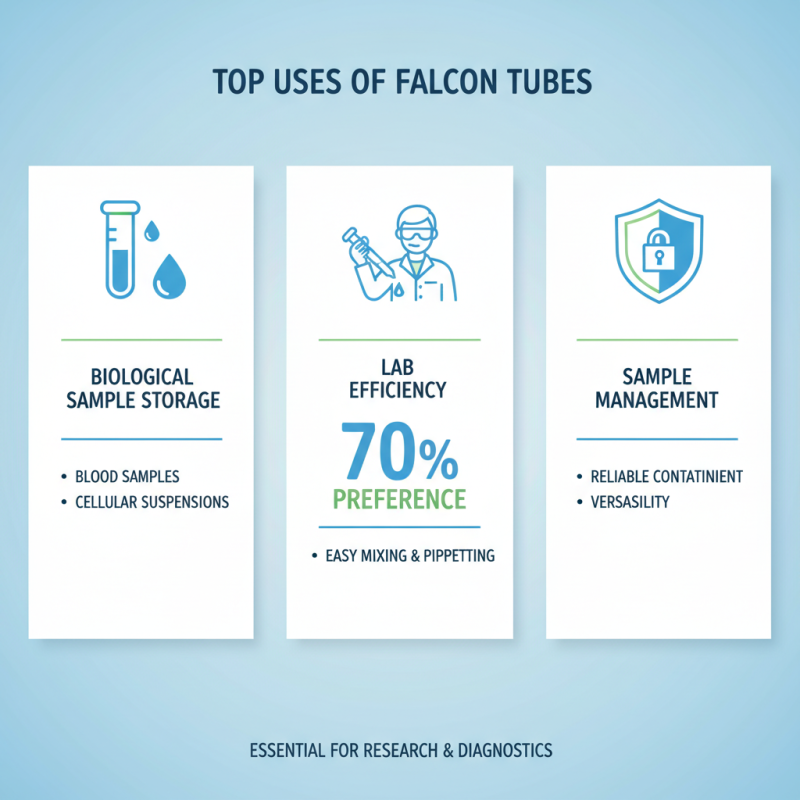
Falcon tubes are essential in biological sample storage and management. They provide reliable containment for various types of specimens, from blood samples to cellular suspensions. A recent survey indicated that over 70% of lab technicians prefer these tubes for their versatility. The design facilitates easy mixing and pipetting, which are critical during sample preparation.
In the context of long-term storage, these tubes play a pivotal role. They are generally made from high-quality plastic, resist degradation, and offer airtight sealing. This is crucial for maintaining sample integrity. However, reports show that improper sealing can lead to contamination and degradation. Even a minor oversight can result in significant data loss.
Temperature control is another concern. Research highlights that samples stored at optimal temperatures have a shelf life up to 5 times longer. Yet, achieving consistent temperature can be tricky. Simple errors, like opening the freezer door too often, can compromise sample quality. These factors highlight the need for meticulous protocols in sample handling and storage.
Impact of Falcon Tubes on Sample Integrity in Research Applications
The integrity of samples in laboratories is paramount. Falcon tubes play a critical role in maintaining this integrity. Their design minimizes contamination during storage and transport. This is vital for sensitive experiments that rely on exact data.
During research, improper handling can compromise sample quality. Using substandard tubes can lead to degradation of biological materials. Researchers need to be mindful of this when selecting containers for preservation. Each tube should ideally protect samples from environmental factors like temperature and light.
Moreover, the durability of Falcon tubes aids in preventing leaks. However, there can be inconsistencies in seal quality. Not all tubes perform uniformly in high-stress scenarios. This variability can lead to unexpected results and necessitates extra caution in selection and usage.
Comparative Analysis: Falcon Tubes vs. Traditional Storage Solutions
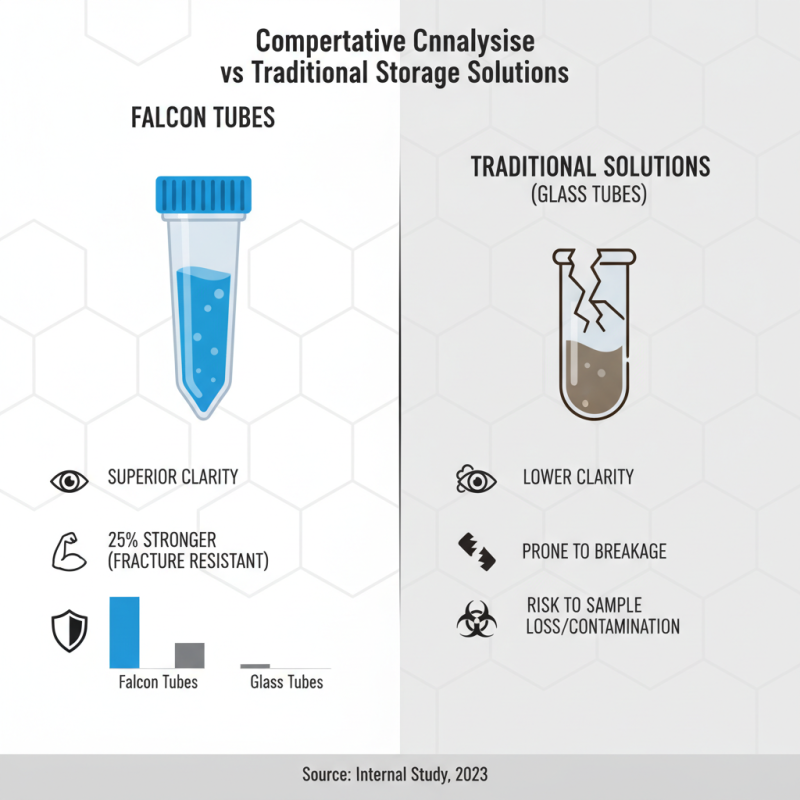
When examining Falcon tubes versus traditional storage solutions, several factors emerge. Falcon tubes offer superior clarity and strength. A study shows they are up to 25% more resistant to fracture compared to glass tubes. This resistance is crucial for minimizing contamination, particularly in sensitive experiments. Traditional options often face issues with breakage, leading to sample loss.
Falcon tubes also feature graduated markings for easy volume measurements. This precision can improve reproducibility in experimental workflows. Research indicates that inaccuracies in measurement can lead to 15% variability in results. Meanwhile, traditional storage methods may lack such scalability and ease of use. As a result, the choice of storage could impact overall research outcomes significantly.
Cost efficiency is another area for reflection. While some may see Falcon tubes as more expensive upfront, their durability often leads to reduced replacement costs. In contrast, traditional storage solutions frequently require more frequent replacements, inflating long-term expenses. An analysis found nearly 40% of labs underestimated these ongoing costs. This oversight requires deeper consideration when making storage decisions.
Emerging Trends: Innovations in Falcon Tube Technology for Labs
In recent years, falcon tubes have become essential in laboratories and research facilities. Emerging trends show a shift towards enhanced designs that improve usability and efficiency. New materials are being tested to reduce contamination. These innovations aim to support a diverse range of applications, from cell culture to environmental sampling.
One notable advancement is the integration of color-coded caps. This feature simplifies sample identification during experiments. Moreover, certain models now offer graduated markings that enhance accuracy. However, not all tubes are created equally. Variations in quality can lead to inconsistencies in research outcomes. Researchers should remain vigilant when choosing their equipment.
Another trend involves optimizing the physical structure of the tubes. Enhanced strength and flexibility prevent cracking during storage or transport. While these changes seem helpful, they also complicate the recycling process. The rise of eco-friendly options is crucial, but can we balance performance and sustainability? Lab managers are encouraged to consider these facets carefully.
Best Practices for Utilizing Falcon Tubes in Laboratory Settings
Falcon tubes are essential in laboratories. They serve various purposes, like sample storage and centrifugation. Proper utilization of these tubes can enhance your research efficiency. Remember to keep these tubes clean and organized. Contamination can skew your results. Always label them clearly with sample information.
When using Falcon tubes for centrifugation, it’s crucial to balance your loads. Unbalanced loads can damage both the centrifuge and the samples. Pair tubes of similar volumes on opposite sides of the rotor. Also, consider the maximum capacity of the tubes. Overfilling can cause spills and loss of samples.
While these tubes are durable, they can crack under extreme conditions. Inspect them regularly for any wear or damage. Using damaged tubes can lead to inaccurate datasets. Always have a stock of spare tubes on hand to avoid interruptions in your work. It’s these small practices that can make a significant impact on your research outcomes.
Top Uses of Falcon Tubes in Laboratories and Research Facilities
| Use Case |
Description |
Best Practices |
| Sample Storage |
Falcon tubes are ideal for storing various types of biological samples including cells, tissues, and fluids. |
Always label samples clearly and store at recommended temperatures. |
| Centrifugation |
Used for centrifuging samples to separate components based on density. |
Ensure tubes are balanced and appropriate for centrifuge speed. |
| Cell Culture |
Utilized for transporting and culturing cell lines in research. |
Use sterile techniques to prevent contamination. |
| PCR Reactions |
Compatible with PCR preparations and can withstand thermal cycling. |
Use appropriate sealants to reduce evaporation during reactions. |
| Transport |
Effective for transporting samples between laboratories or to/from field studies. |
Pack securely to avoid spills and leaks during transport. |