Top Glass Slides for Laboratory and Educational Use?
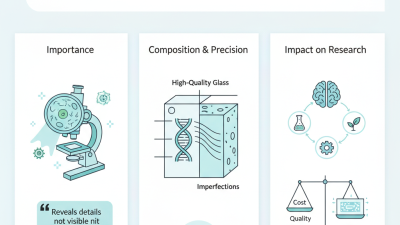
In laboratory settings and educational environments, glass slides are invaluable tools. Dr. Emily Foster, a renowned expert in microscopy, once stated, "Quality glass slides enhance clarity and accuracy in research." This highlights the importance of selecting the right glass slides for various applications.
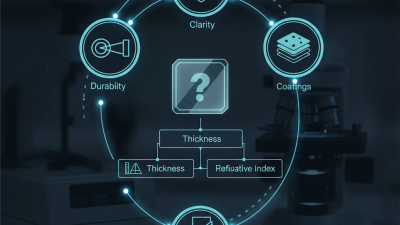
The variety of glass slides available today can be overwhelming. Choices range from standard microscope slides to specialized options for specific experiments. Users must consider factors like thickness, surface treatment, and clarity. A knowledgeable choice can drastically impact research outcomes.
Despite their widespread use, many individuals may overlook the subtle differences that quality glass slides present. Simple decisions about slides can influence the resolution of observations under a microscope. It's crucial to reflect on whether the choices made truly serve the research or educational goals. Investing time in understanding glass slides can lead to profound improvements in scientific exploration.

Top Glass Slides: An Overview of Laboratory and Educational Applications
Glass slides are essential tools in both laboratory and educational settings. They provide a clear surface for examining specimens under microscopes. Their clarity and durability make them ideal for various applications like biology and chemistry experiments. For instance, a student might place a tiny insect or a leaf section on a slide to observe its structure in detail.
In laboratories, professionals often use these slides for preparing thin sections of samples. Such sections allow for more precise examinations. While glass slides are reliable, students might find them fragile. Dropping a slide can lead to breakage, causing frustration. It’s crucial to handle them with care to avoid accidents.
Moreover, slides come in different sizes and thicknesses. This variation can impact how specimens appear under magnification. Educators encourage students to explore these differences, promoting a deeper understanding of microscopy. Observing nuances in samples fosters curiosity. However, many learners may overlook the importance of technique when preparing their slides. Mastering this skill requires practice and patience.
Top Glass Slides for Laboratory and Educational Use
| Type |
Dimensions (mm) |
Thickness (mm) |
Material |
Applications |
| Standard Glass Slide |
75 x 25 |
1.0 |
Soda-lime Glass |
Microscopy, Staining |
| Cover Glass |
22 x 22 |
0.17 |
Soda-lime Glass |
Overlay for Slides |
| Frosted Glass Slide |
75 x 25 |
1.0 |
Soda-lime Glass |
Labeling Samples |
| Specialty Slide |
75 x 50 |
1.0 |
Quartz Glass |
High-Temperature Applications |
Key Specifications of Laboratory Glass Slides: Thickness, Dimensions, and Quality
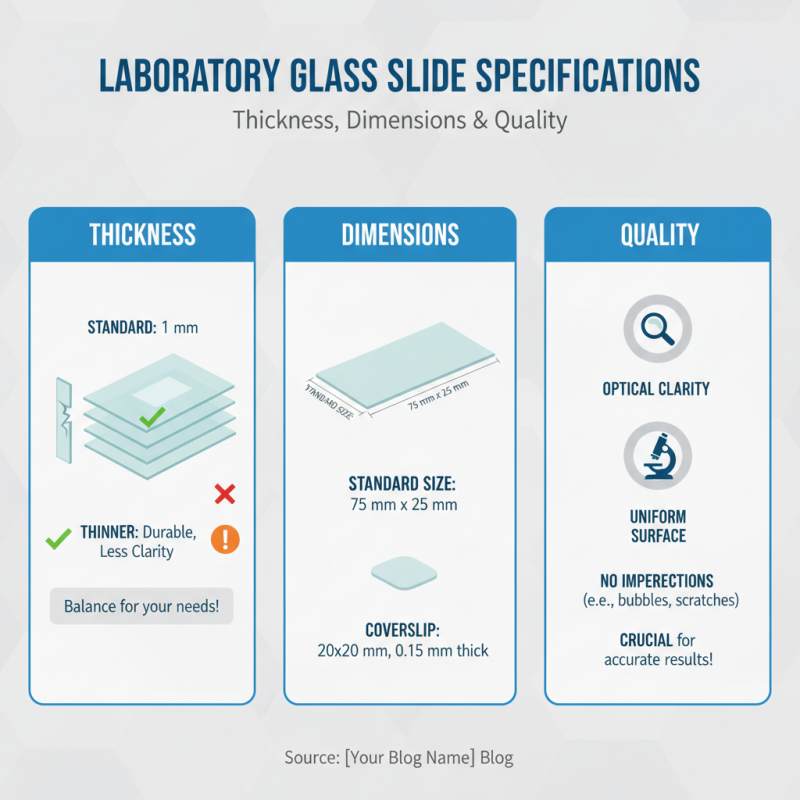
When selecting glass slides for laboratory and educational use, thickness is a primary consideration. Standard slides usually have a thickness of 1 mm. However, variations exist. Thinner slides are often fragile. They can break easily during handling. On the other hand, thicker slides can be more durable but may affect viewing clarity. Evaluating the right balance for your specific needs is essential.
Dimensions also play a vital role. Standard size is about 75 mm x 25 mm. This size fits most microscopes. However, certain experiments may require custom dimensions. Always ensure that the slides match your equipment. Quality is another crucial factor. High-quality glass slides are free from bubbles and imperfections. This clarity improves visibility when examining samples.
Cost often influences selection. Cheaper slides may seem appealing. However, they can lead to unreliable results. Investing in quality slides fosters confidence in your work. It could save time in the long run. Relying solely on price might be shortsighted. Assessing each element ensures successful outcomes.
Comparative Analysis: Standard vs. Specialty Glass Slides in Education
When comparing standard and specialty glass slides for educational settings, various factors must be considered. Standard glass slides are often cheaper and more widely available. They are ideal for basic applications, but their limitations become apparent in advanced studies. For instance, they may not offer the necessary durability for prolonged experiments. The risk of breakage can be an issue in dynamic classroom environments.
On the other hand, specialty glass slides provide enhanced features. They may be treated for specific uses, such as fluorescence microscopy or high-temperature experiments. These slides can withstand harsher conditions, providing more reliable results. However, they typically come at a higher cost, which might not be feasible for all educational institutions. Teachers and students should weigh these options carefully. Understanding the specific needs of their experiments can lead to better learning outcomes. The choice depends not only on budget constraints but also on the educational goals of the curriculum.
Emerging Trends: Eco-Friendly Alternatives to Traditional Glass Slides
In recent years, eco-friendly alternatives to traditional glass slides have gained traction in laboratories and educational settings. These alternatives often utilize biodegradable materials that reduce environmental impact. They can serve the same purpose as glass slides while being lighter and safer to handle, promoting sustainability in science education.
When choosing eco-friendly slides, consider the materials used. Some options are made from plant-based polymers, which decompose naturally. Look for slides that are compatible with your staining procedures. Always check their transparency and durability. Optimal visibility is paramount, especially when viewing delicate samples under a microscope.
TIP: Invest in reusable slide covers. They work well with eco-friendly slides and reduce waste. Remember, even small changes can significantly impact sustainability. Changes require adjustment, and there may be limitations in traditional methods. Embrace the learning curve as you explore these new materials and find what works best for your needs. Commit to continuous improvement in the lab by staying informed about emerging trends.