What is a Falcon Tube and How is it Used in Laboratories?
Falcon tubes are essential tools in modern laboratories. These versatile containers are widely used for various biological and chemical applications. Dr. Emily Tran, a leading expert in laboratory equipment, once stated, "Falcon tubes have revolutionized sample storage and handling." Her words highlight the significance of these tubes in scientific research.
Typically made of high-quality plastic, Falcon tubes provide durability and reliability. They range in size, commonly from 15 mL to 50 mL. This variety allows researchers to choose the best fit for their needs. The secure screw cap ensures that samples remain sealed and uncontaminated. However, one must always consider proper disposal methods after use.
Falcon tubes support a range of laboratory techniques, from centrifugation to cell culture. Yet, it's crucial to reflect on their environmental impact. Not all laboratory practices incorporate responsible waste management. With continuous advancements in research, the role of Falcon tubes may evolve. Maintaining a balance between efficiency and sustainability should be a priority in laboratory settings.

What is a Falcon Tube?
A Falcon tube is a common piece of laboratory equipment. It is a cylindrical, conical tube primarily made of polypropylene. Typically, these tubes hold 15 mL or 50 mL of liquid. Their design allows for easy mixing and storage of samples. In many laboratories, Falcon tubes serve as the go-to containers for cell culture, storage of samples, and even centrifugation.
According to a report from the Journal of Laboratory Automation, over 70% of biomedical labs utilize Falcon tubes. This popularity stems from their reliability and versatility. With graduations marked for precise measurements, researchers can handle various tasks efficiently. However, improper use can lead to contamination or sample loss. The screw cap design is beneficial but can sometimes make it challenging to achieve a secure seal.
In synthetic biology, these tubes aid in successful experiments. Still, they are not without their drawbacks. For instance, while they are often autoclavable, repeated sterilization can affect their integrity. Researchers must be mindful of these factors when choosing containers for their experiments. Accurate data collection is crucial for reproducibility, and every detail matters.
Falcon Tube Usage in Laboratories
Materials and Design Features of Falcon Tubes
Falcon tubes are essential tools in many laboratories. These conical tubes, often made from high-quality polypropylene, excel at holding samples. Their design includes a tapered bottom that facilitates sedimentation. This feature is crucial for centrifugation processes, where separating components quickly is necessary.
The materials used in Falcon tubes allow for high durability. Polypropylene is resistant to various chemicals and can withstand numerous sterilization cycles. Additionally, many tubes have graduation marks for precise measurements. These marks help avoid guesswork during experiments. Their screw-cap lids provide a secure seal, ensuring samples remain uncontaminated. However, it's important to regularly inspect the integrity of the caps to prevent mishaps.
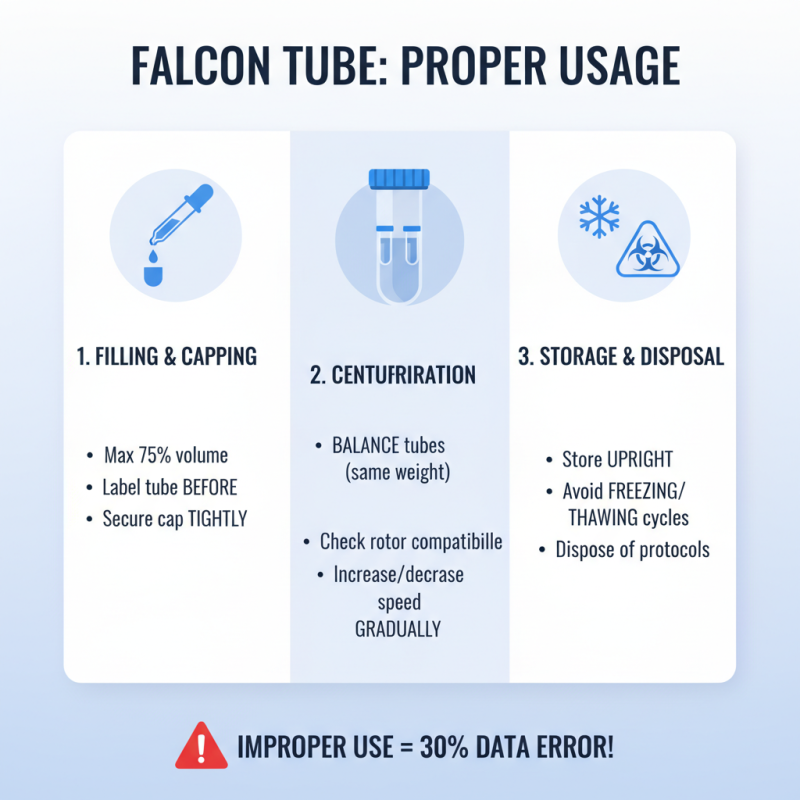
Tips: Always label your tubes clearly. A simple label can save time during analysis. Additionally, consider the tube size based on your sample volume. Using the wrong size could lead to overflow or insufficient sample storage. Lastly, ensure you understand the maximum speed rating for centrifugation. Exceeding this can cause breakage, leading to sample loss. It's crucial to assess these factors to maintain reliability in results.
What is a Falcon Tube and How is it Used in Laboratories? - Materials and Design Features of Falcon Tubes
| Feature |
Description |
| Material |
Polypropylene (PP) or Polyethylene (PE) |
| Volume Capacity |
Typically ranges from 5 mL to 50 mL |
| Closure Type |
Screw cap, often with a seal for airtight closure |
| Graduations |
Marked at intervals for easy measurement of liquid |
| Temperature Resistance |
Can withstand temperatures from -80°C to 121°C |
| Applications |
Cell culture, sample storage, and centrifugation |
| Sterilization |
Often autoclavable for sterilization |
| Design Features |
Conical bottom for easy sample retrieval |
Common Laboratory Applications of Falcon Tubes
Falcon tubes are versatile laboratory tools widely used in various applications. Their design allows for ease of use and reliable sample storage. One common application is in cell culture. Scientists often use these tubes to store and manipulate cell suspensions. According to a report by Lab Manager, about 70% of labs use Falcon tubes for this purpose.
Another significant use of Falcon tubes is for centrifugation. They can withstand high g-forces, making them ideal for separating components in a mixture. This behavior is crucial in biochemistry labs. A study highlighted that proper centrifuge use could improve purity levels by up to 95%. Such efficiency enhances experimental reliability, yet researchers must remain aware of potential contamination risks.
Additionally, Falcon tubes serve as storage vessels for biological samples. They can hold various liquids, from reagents to DNA samples. Researchers should regularly assess the integrity of their tubes. Minor defects can affect results, leading to unreliable data. Striking a balance between efficiency and quality control is essential for achieving accurate outcomes.
Proper Usage and Handling of Falcon Tubes
Falcon tubes, commonly known as centrifuge tubes, are essential in laboratories for sample storage and centrifugation. Proper handling of these tubes can significantly affect experimental outcomes. According to a recent industry analysis, improper usage can lead to contamination, which may compromise data integrity by as much as 30%. Therefore, understanding their correct use is vital for accurate results.
When working with Falcon tubes, ensure a clean environment. Contaminated tubes can introduce variables that skew results. Always label the tubes clearly with sample information and dates. Storing samples at the correct temperature is crucial. For example, freezing samples at -80°C preserves their integrity for extended periods. Using the correct centrifuge settings is also important to prevent damaging the samples or the tubes.
Despite their robustness, Falcon tubes can break under excessive force. Handling them with care is essential to avoid accidents. Regular training on proper techniques is highly recommended. Many laboratories report that improved training reduces mishandling incidents by 25%. Collaborating with peers to share best practices can further enhance safety and reliability in the lab.